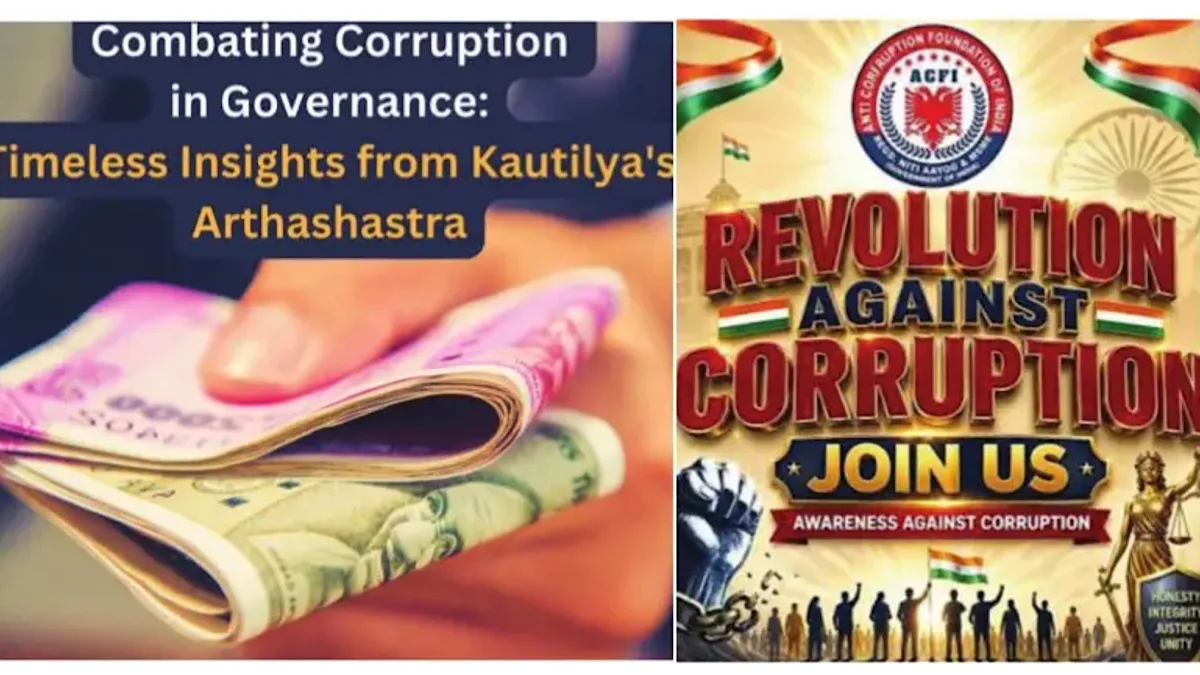
A file sits on a clerk’s desk. It is complete, stamped, in order ~ and it will not move. The applicant, a farmer or a small contractor or a widow chasing a pension, learns the unwritten tariff: a little cash to the right hand, and the file walks. Repeated ten thousand times a day across the country, the scene has lost its power to shock us; we have come to treat petty corruption as weather, a thing to be endured rather than ended. Yet a counsellor who advised an emperor twenty-three centuries ago saw it coming, named it precisely, and prescribed the remedy.
We have spent the years since mislaying both the diagnosis and the cure. The counsellor was Kautilya, and his Arthashastra remains the most clear-eyed manual of statecraft India has produced. Its premise, and the premise of the wider tradition behind it, is one our public life has quietly abandoned: that political office is not a privilege to be enjoyed or a spoil to be shared, but a trust to be discharged. The oldest layer of that tradition puts it most starkly.
Advertisement
“Enjoy through renunciation,” the Isha Upanishad commands in its opening verse; “do not covet the wealth of another.” The exchequer is not the minister’s to enjoy; it is held in trust for the citizen, and to covet it is to break an order older than any statute. The Sanskrit name for the duty is rajadharma ~ the dharma, the binding obligation, of those who hold power. By that measure corruption is not merely a leakage of revenue. It is a breach of the single thing that gives office its legitimacy. What makes Kautilya bracing rather than pious is his realism. He did not expect officials to be honest; he expected them to steal, and said so in a sentence that has never been bettered.
“Just as it is impossible not to taste the honey or the poison that finds itself at the tip of the tongue,” he wrote in the second book of the Arthashastra, “so it is impossible for a government servant not to eat up at least a bit of the king’s revenue.” This is not the voice of a moralist wringing his hands. It is the voice of an auditor. In the same book he enumerates some forty distinct ways in which a treasury can be quietly bled ~ a receipt entered late, a payment entered early, a sum booked under one head that belongs under another ~ the obsessive taxonomy of a man who has read real ledgers. Having assumed the disease, he devoted long passages to its containment: overlapping surveillance, the rotation of officers so that none grew roots in a post, the patient reconciliation of accounts, rewards for informers, and punishment swift enough to be feared. He understood, as we periodically forget, that virtue cannot be legislated but theft can be made expensive.
If Kautilya supplies the mechanism, the dharmic tradition supplies the purpose the mechanism serves. In the Shanti Parva of the Mahabharata, the dying Bhishma instructs Yudhishthira at length on the conduct of a ruler, and returns again and again to a single duty: the protection of the governed. The king who protects his subjects, Bhishma says, earns a fourth part of the merit they accumulate under his care; the king who fails to protect them takes, in the same measure, a share of their suffering and their sin. Power is morally load-bearing. It cannot be neutral. The tradition’s quiet radicalism lies just here: the ruler exists for the ruled and never the reverse, and the throne is owed to the kingdom rather than the kingdom to the throne.
The Bhagavad Gita then sharpens the point to its finest edge: “Whatever a great man does, others follow; whatever standard he sets, the world pursues” (3.21). A leader does not govern chiefly through his orders. He governs through his example, which a watching public reads more accurately than any speech. The same conviction runs, in two unforgettable couplets, through the Tamil canon. Tiruvalluvar, in the Thirukkural, sets the ideal and its betrayal side by side. As the whole world looks to the sky for rain, runs the fifty-fifth chapter, so all the people look to the sceptre of their king ~ justice imagined as the monsoon on which an entire society depends for its harvest of order.
And in the chapter that follows, the betrayal: the ruler who holds the sceptre and yet extorts from those beneath it, Valluvar writes, is no better than a highwayman who stands with a spear and says, simply, “give.” Two thousand years before the phrase “speed money” entered our offices, a Tamil poet had drawn the line between the protector and the brigand, and warned how thin it is. Here the tradition turns, and its turn is the lesson we most need. The temptation, in any season of disgust with public life, is to reach for one of two easy answers. The first is the moral appeal ~ exhortation, oath-taking, the hope that better men will simply behave better.
Kautilya, who watched honey meet tongue, knew this was insufficient. The second is the opposite faith, fashionable in our own age: that the right institutional machinery ~ another commission, another portal, another agency ~ will deliver integrity on its own. But a mechanism without an animating ethic decays into ritual, and the anti- corruption body becomes one more office with its own unwritten tariff. The Indian answer was never one or the other. It was both, bound together, and bound first upon the ruler himself. Manu, in the seventh chapter of his code, calls the rod of punishment ~ danda ~ the true sovereign, the protector of all, the very embodiment of law; and he is emphatic that the rod, wrongly or partially wielded, destroys the one who holds it.
The king is not above danda; he is its first subject. Dharma supplies the conscience and danda the consequence, and a polity that loses either is left with sermons or with cynicism. Translate that into the present, and the demand on a politician becomes concrete, and uncomfortable. It is not enough to denounce corruption in others; the standard begins at home, in the honest declaration of one’s own assets, the sources of one’s own funds, the conduct of one’s own family and office. It is not enough to build agencies; they must be free to act without fear or favour, including against the hand that built them. It is not enough to pass a budget; the money voted for the school and the clinic must arrive there, undiminished by the journey.
And it is not enough to win an election; office won is a debt incurred, repayable only in protection ~ of the farmer’s file, the widow’s pension, the contractor’s fair tender. A leader who grasps this leads, in the Gita’s sense, by becoming the standard. A leader who does not is the brigand with the sceptre, however large his mandate. None of this is nostalgia. Of the 543 members elected to the Lok Sabha in 2024, the Association for Democratic Reforms found that 251 ~ almost half ~ took their seats with criminal cases declared against them; declared, the law rightly insists, is not the same as convicted, but a republic that reveres rajadharma cannot shelter behind the distinction.
India scores 39 out of 100 on Transparency International’s 2025 Corruption Perceptions Index, 91st of 182 countries and below the global midpoint. These are verdicts on a trust imperfectly kept. But the texts that judge us are also the texts that instruct us, and they are not foreign imports; they are the inheritance of the very civilisation whose name our politicians invoke most loudly. The farmer still stands at the counter, looking up. He is doing what the Kural said he would do ~ watching the sceptre as the parched field watches the sky. The only question our public life has to answer is the oldest one: when he looks up, will the rain come?
(The writer is a practising Chartered Accountant and a Vedantic scholar, and can be reached at kannan@cakt.in)